Q&A with Anuj Shah and Jean Muller of Khaitan & Co.
This Q&A was published in IHC eMagazine Vol1, Issue 1. to read the full magazine, please click here.
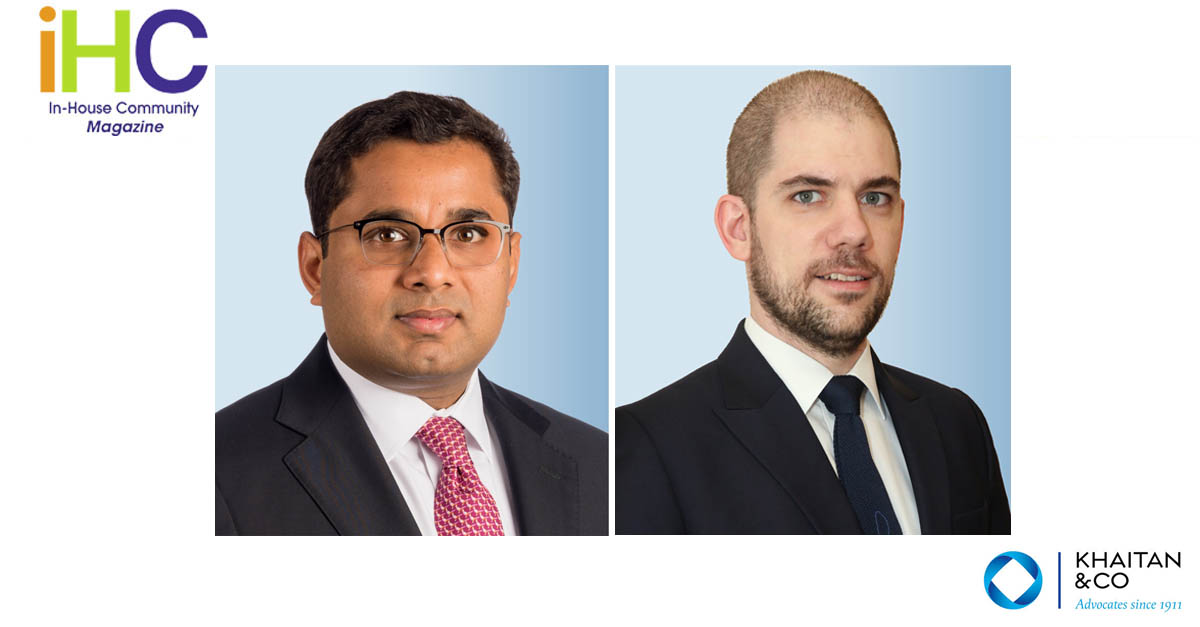
IHC speaks to Anuj Shah (partner) and Jean Muller (director of strategy) of Indian law firm, Khaitan & Co about the firm’s recent move to open an office in Singapore.
Despite the pandemic, Khaitan & Co opened an office in Singapore. What drove drivers that decision?
Jean: Over the last two decades, India has gradually integrated into the global economy and now legal advisors here do a lot of cross-border work. Singapore is the preferred hub in the Asia-Pacific for deal-making since it hosts a critical mass of advisors, decision-makers and providers of capital. We wanted to help our clients address this increasingly complicated world and so acted accordingly. We are seeing unparalleled demand for Indian legal services in Singapore. So, this decision made perfect sense. It took a couple of years to carefully plan our first foray overseas but we believe the market has reached a point where we can add value for our clients by setting up a local presence.
Why is Singapore so important to Indian businesses?
Anuj: We see a convergence of factors. Singapore’s financial markets were always critical to Indian businesses, even more so nowadays with new sources of funds to tap for stressed and distressed players. Another factor is the Indian corporate environment is highly litigious. Given the delays to get justice in India, international arbitration has become prevalent, with Singapore-seated arbitrations getting the lion’s share of that market. Today, a majority of SIAC cases involve an Indian party, and many of the disputed contracts are governed by Indian laws.
In recent years, many Indian business owners and high-net-worth individuals have relocated their assets and/or families to Singapore. The city-state is a springboard to explore global markets, either through family offices or restructured holding companies.
Lastly, several new Indian businesses set their holding companies in Singapore with an eye on an eventual public listing. This is amplified by the wave of de-SPAC transactions hitting Indian shores. It is much easier to merge a Singapore entity with a SPAC.
How will you position your firm to compete in such a saturated market?
Jean: Our value proposition is clear and unique. We exclusively provide top-end Indian law services to Indian and foreign clients based out of Singapore. We will have a team on the ground able to handhold clients through projects and leverage the expertise of 150+ partners based in India.
While Singapore already has a rich ecosystem of law firms, we see that depth as an advantage. We will not compete directly with international or regional firms but will aim to enhance collaboration. For example, global financial sponsors entering the Indian market may want to be supported by a combination of their preferred international advisors and local experts working symbiotically. Similarly, on arbitration matters, we may need to team up with a Singaporean firm for procedural aspects. We could also support international firms in the interpretation of Indian law clauses in a disputed contract.
Could you tell us more about your practice and its relevance to this corridor?
Anuj: I am primarily a cross-border M&A lawyer. Over the years, I have developed niche expertise in two market segments, namely insurance M&A and supporting owners of large Indian businesses on bet-the-company operations, including transformative transactions and critical disputes. These areas have a significant Singapore angle for us:
- many cross-border JVs in India’s insurance sector involve stakeholders based in Singapore;
- a lot of our Indian HNWI clients have a presence in the city-state; and
- many get into cross-border disputes too. For example, my biggest matter in the last few quarters has been a major arbitration, for which I advise a HNWI client in collaboration with our Dispute Resolution team.
What about Khaitan & Co’s longer-term ambitions in the region?
Jean: Our ambition will always be to provide top-quality Indian law advice. Through that office, we may over time cover more practice areas and, depending on the success of our Singapore venture, we may in the longer-run use those lessons to explore offices in other major international legal hubs as well.

Anuj Shah is a partner in M&A and Private Client Practice with Khaitan & Co. Anuj has over 15 years of experience advising corporations, financial institutions, private equity sponsors and sovereign wealth funds in a broad range of corporate matters and M&A transactions. He also acts as a trusted advisor to several Indian promoters on a wide range of personal and corporate matters.

Jean Muller is director of strategy with Khaitan & Co. Jean has over 12 years of experience as a strategy professional in Europe, the UK and India. He oversees the firm’s international coverage and business development function, while supporting many other long term strategic initiatives.